Thursday, July 21, 2005

So Long Mr. Scott

James Doohan led a varied and eventful life. So much so that his biography "Beam Me Up Scotty!" is a very interesting read. Did you know that Scottys' middle name Montgomery actually comes from Jimmy Doohans' grandfather, a Scottish sea captain by the name of James Montgomery - Jimmy would also seem to have taken after him in that his mother was born when his grandfather was over seventy! Jimmy and his wife Wende were blessed with their youngest child when he was eighty.

On Wednesday 7/20 Doohan died at his home in Redmond, Wash., with his wife of 31 years, Wende, at his side. He had retired from public events last year, not long after announcing he had Alzheimer's disease.

Houston-based Space Services Inc., which specializes in space memorials, plans to send a few grams of Doohan's ashes aboard a rocket later this year. The remains, which will be sealed in an aluminum capsule, will eventually burn up when they re-enter Earth's atmosphere.

Wednesday, July 20, 2005

More Flash Demos of Hacks from WHAX

http://eks0.free.fr/whax-demos/

Also, here are some other demos incuding one using Whoppix/WHAX on WEP.

Tuesday, July 19, 2005

Event Log Explorer 1.2

Event Log Explorer allows administrators to view, monitor and analyze events recorded in the Security, System, Application and other logs. The program extends the features of the standard event log viewer by offering detailed filtering capabilities, that allow you to view events by category, event ID, event type, user, as well as by date or keyword match. Event Log Explorer can also export your evnts as HTML or printable text report.

And it is freeware...

Causes of Suicide Terrorism

Here's a very fascinating interview with Robert Pape, a University of Chicago professor who has studied every suicide terrorist attack since 1980.

Monday, July 18, 2005

Financial Security or Things Obaid Hasn't Told You

Deficit Falls

The projected federal budget deficit has decreased by nearly $100 billion thanks to unexpected increases in tax payments. Rising corporate profits, up 40 percent over 2004, provided most of the extra money.

Gas

Does the average price of a gallon of gas at $2.328 got you in the dumps? You should know this - We are still better off than we were in March 1981 when the real cost of fuel hit its all time high. Back them a gallon cost $1.417 the equivalent of $3.107 a gallon today in inflation adjusted dollars!
SUVs rock!

Unemployment Hits Four-Year Low

Unemployment in June fell to 5%, the lowest level in nearly four years. The drop of 224,000, was the greatest monthly decline in more than a decade.

Saturday, July 16, 2005

Finger Scanning At Disney Parks Causes Concern

The addition of finger scanning technology at the entrances of Walt Disney World theme parks for all visitors has caused concern among privacy advocates.

"Disney World is now requiring all visitors to have their index and middle fingers scanned to gain entrance to the park. This started for season pass holders, but is now required for everyone."
From the article: "'I think it's a step in the wrong direction,' Civil Liberties Union spokesman George Crossley said. 'I think it is a step toward collection of personal information on people regardless of what Disney says.'"

Disney always gave me the willies... This just adds to it. GP, just think of the germs!

Friday, July 15, 2005

The System Administrator Song

System administrators the world over, rejoice! A song has been sung in your honor. Wes from Three Dead Trolls is at it again with The System Administrator Song. Are you a sysadmin yourself,and/or do you annoy one on a regular basis?

Note: Just because you might have an Administrator account on your system does not necessarily make you a system administrator...

There's a guy who works in another room, or on another floor; He's the one you call, when your document ain't there no more; he's probably a boy, but he might be a girl, or something in between; he's the only one in the office who knows what 'PC Load Letter' means. He's your system administrator; he's probably into comic books; and you tremble in fear when you have to hear one of his 'what a dummy' looks.

Don't forget upcoming System Administrator Appreciation Day!

Fridays are for Fun - DIY Home Projector

Have $200-800 sitting around and some time for tinkering? InventGeek has a project suitable for the novice user. Now you can build your very own LCD projector...

Thursday, July 14, 2005

Domain Name HIJacking: Incidents, Threats, Risks, and Remedial Actions

In a 48 page report the ICANN's Security and Stability Advisory Committee has outlined several famous and recent thefts of websites, including Panix.com, Hushmail.com and HZ.com, and listed where the system went wrong and what can be done to correct the flaws. It has made 10 findings and, in response, 10 recommendations for how the internet industry and consumers themselves can make sure that people don't steal their online property.

Most of the bad guys still aren't that smart (that's the good news)

Taiwan snares "evil dragon" criminal via online game

Taiwan police captured a heavily armed fugitive whom they had been tracking for more than a year on Wednesday after he exposed his whereabouts by playing online computer games. Taiwan evening newspapers said Chang Hsi-ming, wanted for murder, illegal possession of weapons and multiple kidnappings, was found via his Internet protocol address after police found out he often played games online. The head of Taiwan's Criminal Investigation Bureau personally led the siege against Chang's hideout in central Taiwan, with more than 130 police and two armoured vehicles as he was known to be armed with assault rifles and hand grenades.

Illinois Police Arrest Man Who Said He Was Driving To D.C. With Explosives

Terry Daniel, 44, of Cedar Rapids, Iowa, used the words ''bomb,'' ''explosive,'' ''Washington, D.C.'' and ''president,'' over a CB radio around 3 a.m. Wednesday 7/13 while driving eastbound on Interstate 80, Princeton police chief Tom Root told the (LaSalle) NewsTribune.

After hearing his comments, truck drivers alerted the authorities.

Police took the man into custody at a service station off I-80 in this central Illinois town, about 100 miles southwest of Chicago, when Daniel apparently stopped for gas. A search of the van turned up containers and other materials that lent credence to his threat, Root said.

''There were some maps, documents and other things that lead us to believe that he was headed in that direction and that location,'' he said.

Wednesday, July 13, 2005

KCPenTrix ver 1.0 released today

Lots of SLAX activity in the last few days...

KCPentrix is a new liveCD designed to be a standalone Penetration testing toolkit for pentesters and security analysts. KCPenTrix is based on SLAX, a Slackware live CD and gentoo,auditor and whoppix.

Tuesday, July 12, 2005

Whoppix is DEAD - Long live WHAX!

WHAX is the natural evolution of WHoppix - a live cd, standalone penetration testing toolkit. There are some major new features in WHAX which add huge functionality compared Whoppix, and may change the way we use live distributions.

The big change is that WHAX is so longer based on Knoppix, but on SLAX, a Slackware live cd. One of the main reasons for this change is the wonderful world of modularity which SLAX uses.

This modularity means that versions of WHAX can be easily customize to include whichever modules we like. All the tools have been compiled to "WHAX Modules" which can be easily added or removed, depending on your needs.

hackergames.net!

Someplace for George to play when he is done at my house. Within you'll find a comprehensive list of hacking and security related challenges, hackits, wargames, tools, and tutorials, along with user reviews.

Monday, July 11, 2005

Phrack Magazine says Goodbye (for now)

Phrack is an online news service for hackers that has been in business for over 20 years starting initially as a dial-up bulletin board before moving to the web.

The magazine offered insight into all types of hacking, including hijacking wireless base stations in later editions.

The website does note: "We are preparing for a hardcover and ezine release at a major hacker convention near you!". So maybe we have not heard the last from Phrack.

Saturday, July 09, 2005

Internet chatroom helps keep City of London open

Does your business resumption plan have any out-of-band mechanisms in case some of your major systems fail? Even something simple as a published e-mail address not hosted on your own systems may be useful. Perhaps a Jabber server, or an IRC chat room somewhere?

A secret Internet chatroom run by Britain's financial regulators helped keep London's financial markets open after Thursday's bomb blasts, while financial firms activated security measures in case of further attacks.

A Bank of England spokeswoman said this was the first time the secure site had been used in an actual crisis situation since its creation in the wake of the Sept. 11, 2001 attacks on the World Trade Center in New York.

Friday, July 08, 2005

Fridays are so so special!

This weekend - spend some quality time searching for old pals, watch a little TV, make sure you are update-to-date with all your Microsoft patches via Firefox (yes it can be done), and for when you are all done, here's a bar of vibrating soap.

Thursday, July 07, 2005

London Rocked by Four Blasts

An organized Flickr photo collection of London's terrorist attack on July 7, 2005.

Take a moment and send them some goodwill in whatever fashion you see fit... even if you're not one of the persons wondering if friends, coworkers or family are among lost or injured.

My Mom would probably suggest prayers...

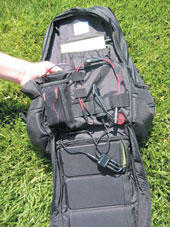
Turn Yourself into a Walking Hotspot

How to article on turning yourself into a walking hotspot by using a mobile power source and a cellular-to-Wi-Fi gateway.

The Voltaic Systems backpack makes a great platform to build from due to all of the internal wiring and myriad power adapters included in the kit. The Junxion Box is a simple, clean appliance to handle the Wi-Fi to Cellular interface.

The Junxion Box requires a 12 volt power source. So, natch, a lead-acid battery would feed it the juice it needs. Starting with a 1.2 Amp-hour battery will let the whole kit run a few hours. (The Box draws between 200 mA and 500 mA of current while active.) Adding a bigger battery will lengthen your run time. Solar adds a bit of extra runtime and will keep your battery topped off when the system isn't running.

The full article gives step-by-step and a parts list for you to make your own.

Wednesday, July 06, 2005

Browser Identification For Web Applications

Browser Identification is not a new concept. With the focus having shifted to desktops from networks and servers, a topic such as remote browser identification needs to be revisited.

Browsers identify themselves to web servers in the USER_AGENT header field that is contained in requests sent to the server. Almost every release of browsers contains sloppy code that allows malicious servers or attackers to compromise user privacy and security.

This paper outlines techniques that allow users to determine client browser types remotely.

Download the paper in PDF format here.

Tuesday, July 05, 2005

In the stolen-data trade, Moscow is the Wild East

The most expensive wares in Moscow's software markets, the items that some Russians are calling a threat to their personal safety, aren't on public display.

It takes less than 15 minutes to find them, however, at the teeming Gorbushka market, a jumble of kiosks selling DVDs, CD-ROMs and an array of gadgetry in an old factory west of downtown.

One question -- Where can we buy databases of private information? -- and the young man selling rip-off copies of Hollywood movies leaps to his feet. He leads the customers to another vendor, who wears a bull's head on his belt buckle. This second man listens to the request, opens his cellphone, and punches a speed-dial number.

Moments later, a third vendor appears. He is jovial and blunt about his trade.

"What do you need?" he says. "We have everything."

Monday, July 04, 2005

Pop-up Smut Tops Spyware Chart

A strain of spyware that displays pornographic pop-ups has retained its place as the top spyware nuisance on the net last month. ISTbar was responsible for 3.5 per cent of infections detected by Panda Software's free online malware scanner, more than any other spyware or adware application.

ISTbar, which poses as an ActiveX control, acts as an entry-point for other malware, adware and dialers. It also displays pornographic pop-ups, installs a toolbar and changes the home page of browsers on infested PCs.

Cydoor, an adware program that downloads advertisements from a server and displays them on PCs, made runner-up spot on Panda's June list of spyware nasties as nabbed by Panda's ActiveScan service, which was recently upgraded to add spyware detection alongside its existing virus busting features. Panda's June spyware chart features only one new entry, an adware package called MarketScore.

Spyware refers to a class of invasive program that generates pop-ups, hijacks user home pages or redirects searches in an attempt to either monitor user activity or bombard surfers with unwanted messages. It's a fast growing category that is beginning to eclipse more clear-cut malware - such as computer viruses - in economic impact if not in prevalence.

Top spyware threats, as compiled by Panda Software

1. ISTbar
2. Cydoor
3. New.net
4. XXXToolbar
5. Dyfuca
6. BetterInet
7. Petro-Line
8. Altnet
9. BargainBuddy
10. MarketScore

Sunday, July 03, 2005

Critical Information for the Traveling Public

Taking a trip this summer? Before you hop on that plane, you might want to check the latest info at AirSafe.com.

Real Homeland Security

Headed to that neighborhood BBQ or fireworks for the 4th... Check to see who might be back at your house going through your underwear drawer.

Friday, July 01, 2005

Security Skins - Better than Passmark?

Much has been written about the insecurity of passwords. Aside from being guessable, people are regularly tricked into providing their passwords to rogue servers because they can't distinguish spoofed windows and webpages from legitimate ones.

Here's a clever scheme by Rachna Dhamija and Doug Tygar at the University of California Berkeley that tries to deal with the problem. It's called "Dynamic Security Skins," and it's a pair of protocols that augment passwords.

First, the authors propose creating a trusted window in the browser dedicated to username and password entry. The user chooses a photographic image (or is assigned a random image), which is overlaid across the window and text entry boxes. If the window displays the user's personal image, it is safe for the user to enter his password.

Second, to prove its identity, the server generates a unique abstract image for each user and each transaction. This image is used to create a "skin" that automatically customizes the browser window or the user interface elements in the content of a webpage. The user's browser can independently reach the same image that it expects to receive from the server. To verify the server, the user only has to visually verify that the images match.

Friday Already? Time for Golf!

Having ball control issues? This should help secure a win!

LucidLink Releases Demo Chronicling Wi-Fi Hacker Attack

To truly understand a criminal, you have to get inside his mind and think as he does. Follow his steps. See what he sees. LucidLink Wireless Security has done just that, creating a Flash demonstration that chronicles the steps hackers follow while tapping into wireless networks to gain access to confidential information. In an attempt to raise awareness about the security implications of unsecured wireless networking, LucidLink has recently added the demonstration to its website.

The demonstration takes viewers through a step-by-step explanation of a hacker's activities, explaining how war drivers find wireless networks, gather information about them, and eventually infiltrate them in order to gain access to personal identity and company confidential information. The demonstration uses screen shots captured from freely available hacker programs so that viewers can see what hackers see as they click their way closer to breaking into even secured wireless networks.

Thursday, June 30, 2005

Poop in the News

Man Arrested For Allegedly Hiding In Women's Toilet

Truth really was stranger than fiction in New Hampshire where a man was arrested for allegedly being inside a women's room toilet.

Summer vacationers were disgusted when a man was discovered hiding inside a toilet in the women's room at a rest stop along the Kancamagus Highway near Carroll City. Police said he was in the waste tank beneath a log cabin restroom.

Authorities said Gary Moody, 45, of Gardiner, Maine, somehow got inside a toilet in the women's restroom and stayed there undetected as women used the restroom until a young girl detected him. The teen apparently walked into the restroom and looked down into the toilet and saw Moody looking back up at her.

Police were called in to flush him out.

"It's a very filthy environment and before we put anybody in contact with him we wanted to decontaminate him. We treated him exactly like he was hazardous material," Capt. John Hebert of the Carroll City Sheriff's Department said. "I started in this business in 1980 and I have never in my career encountered anybody in this type of a situation."

Moody was charged with criminal trespassing in and was freed on bail. A court date of July 19 was scheduled in North Conway.

How to Deal with Pushy Security Vendors

Columnist Demetrios Lazarikos is losing patience with security vendors that are all hype and no substance. He offers a few tips on finding the right vendor for your company.

Wednesday, June 29, 2005

What if Operating Systems Were Airlines?

Kind of an airline theme of late... What traveling would be like if compared to using an operating system.

Tuesday, June 28, 2005

Interview with Marcus Ranum

There's some good stuff in this interview.
There's enough blame for everyone.

Blame the users who don't secure their systems and applications.

Blame the vendors who write and distribute insecure shovel-ware.

Blame the sleazebags who make their living infecting innocent people with spyware, or sending spam.

Blame Microsoft for producing an operating system that is bloated and has an ineffective permissions model and poor default configurations.

Blame the IT managers who overrule their security practitioners' advice and put their systems at risk in the interest of convenience. Etc.

Truly, the only people who deserve a complete helping of blame are the hackers. Let's not forget that they're the ones doing this to us. They're the ones who are annoying an entire planet. They're the ones who are costing us billions of dollars a year to secure our systems against them. They're the ones who place their desire for fun ahead of everyone on earth's desire for peace and [the] right to privacy.

Sunday, June 26, 2005

Inside or Outside? Or How Many Warren Lunches Would it Take...

Internal security breaches at the world's banks are growing faster than external attacks, as institutions invest in technology, instead of employee training.

According to the 2005 Global Security Survey, published by Deloitte Touche Tohmatsu, 35 per cent of respondents said that they had encountered attacks from inside their organization within the last 12 months, up from 14 per cent in 2004. In contrast, only 26 per cent confirmed external attacks, compared to 23 per cent in 2004.

The report, which surveyed senior security officers from the world's top 100 financial institutions, found that incidences of phishing and pharming, two online scams which exploit human behavior, are growing rapidly. These scams use bogus e-mails and websites to persuade people to reveal confidential information to hackers and fraudsters. "Completely malicious internal security threats are less likely than those caused through lack of training," said Gerry Fitzpatrick, enterprise risk services partner at Deloitte in Dublin, speaking to ElectricNews.net. "People need to understand how to classify data and treat it in a secure way."

Who Ordered the Curry on Wheat?
An undercover reporter was able to buy the details thousands of UK banking accounts, password particulars and credit cards numbers from crooked call centre workers in India, The Sun reports.

Saturday, June 25, 2005

Airport Security

Note: If you want to pass through airport security faster - select a one-way ticket... Then, you get to go through the "very special" screening. BTW I don't think he was using just the back of his hand...

"Here is a story from Slate on how the current flavor of airport security is pointless, and if anything, actually increases risks - check it out."

Patriotic Ashes

Click here for the PODCAST (2mb MP3) of this post.

A constitutional amendment to ban the desecration of the U.S. flag moved closer to reality Wednesday 6/22 when the House of Representatives passed it 286-130. While this isn’t the first time this has happened, I’m still concerned by the notion of such a bill making it out of the Senate.

Here’s a quick blurb from the USA Today article:

The amendment reads, "The Congress shall have power to prohibit the physical desecration of the flag of the United States." Supporters say the flag should be protected because it symbolizes the freedoms many have died to defend. Flag burning "is a challenge to the institution that defends liberty," Rep. Phil Gingrey, R-Ga., said. "Our flag deserves to be respected and protected because it is more than just star-studded fabric."

Source: kevin pereira dot com

Friday, June 24, 2005

The Adaptability of Iraqi Insurgents

This Newsweek article on the insurgents in Iraq includes an interesting paragraph on how they adapt to American military defenses.

Counterinsurgency experts are alarmed by how fast the other side's tactics can evolve. A particularly worrisome case is the ongoing arms race over improvised explosive devices. The first IEDs were triggered by wires and batteries; insurgents waited on the roadside and detonated the primitive devices when Americans drove past. After a while, U.S. troops got good at spotting and killing the triggermen when bombs went off. That led the insurgents to replace their wires with radio signals. The Pentagon, at frantic speed and high cost, equipped its forces with jammers to block those signals, accomplishing the task this spring. The insurgents adapted swiftly by sending a continuous radio signal to the IED; when the signal stops or is jammed, the bomb explodes. The solution? Track the signal and make sure it continues. Problem: the signal is encrypted. Now the Americans are grappling with the task of cracking the encryption on the fly and mimicking it—so far, without success. Still, IED casualties have dropped, since U.S. troops can break the signal and trigger the device before a convoy passes. That's the good news. The bad news is what the new triggering system says about the insurgents' technical abilities.

The CIA is worried that Iraq is becoming a far more effective breeding ground for terrorists than Afghanistan ever was, because they get real-world experience with urban terrorist-style combat.

Tuesday, June 21, 2005

Deleting Stubborn Files

Do you have stubborn malware infecting your machine? This article offers advice on how to manually delete it without taking the reformatting route.

Monday, June 20, 2005

Airport Xrays Render You Naked!

After spending lots of time at the airport lately... Is an invasive pat-down a bad thing?

President Bush's proposed $2.57 trillion federal budget for Fiscal Year 2006 greatly increases the amount of money spent on surveillance technology and programs while cutting about 150 programs?most of them from the Department of Education. EPIC's "Spotlight on Surveillance" project scrutinized these surveillance programs.

Airport security has undergone significant changes since the terrorist attacks of Sept. 11, 2001. Recently, the Transportation Security Administration (TSA) announced a proposal to purchase and deploy "backscatter" X-ray machines to search air travelers at select airports. TSA said it believes that use of the machines is less invasive than pat-down searches. However, these machines, which show detailed images of a person's naked body, are equivalent to a "virtual strip search" for all air travelers. This proposal, along with the agency's controversial plan to profile air travelers, shows extraordinary disregard for the privacy rights of air travelers. The Department of Homeland Security is requesting $72 million to invest in detection systems, which includes funding for the backscatter machines, which cost between $100,00 and $200,000 each.

Read the rest at http://www.epic.org/privacy/surveillance/spotlight/0605.html, including pictures this technology produces....

Sunday, June 19, 2005

Happy Fathers Day

Words of Wisdom:

Never Say Never...

Saturday, June 18, 2005

Another G-Map Hack

Yet another Google Maps hack has been unleashed upon the unwashed masses. gCensus offers United States Census information merged with Google's powerful mapping tool. The result? Population density and other data sets accurate to a city block!

This is an impressive little hack built with XML, XSLT, CSS, AJAX and the kitchen sink (for good measure).

Friday, June 17, 2005

(IN)SECURE Magazine Issue 2 is out - free download

Source: Insecure Magazine

(IN)SECURE Magazine is a freely available, freely distributable digital security magazine in PDF format. Issue 2 brings topics such as: "Information security in campus and open environments", "Advanced PHP security - vulnerability containment" and "Clear cut cryptography". Get your copy today!

Thursday, June 16, 2005

Picking Physicists' Locks

From Scientific American:

Measured to be equal to 1/137.03599976, or approximately 1/137, [the fine-structure constant] has endowed the number 137 with a legendary status among physicists (it usually opens the combination locks on their briefcases).

So now you know, too.

Wednesday, June 15, 2005

Take this Job and...

Stress what stress?

According to the 2005 Stress of Security Survey, 25% of IT decision-makers surveyed reported that protecting their company against malicious Internet security threats, such as viruses or spyware, is more stressful than a minor car accident. 13% stated that it is more stressful than starting a new job.

Furthermore, when asked about security breaches and the effects on their employment status, 45% of IT decision-makers surveyed believed that lost or stolen intellectual property as a result of an Internet security breach could put their job on the line.

Tuesday, June 14, 2005

Sysadmins Urged to Stop Child Abuse Downloaders

Karen should be so happy...

Sysadmins are urged to stop staff who download child pornography at work under a campaign due to host a free half-day conference in London on Wednesday (15 June). The 'Wipe it Out' event, backed by the Home Office and organised by the Internet Watch Foundation, aims to address the "practical, legal, ethical and corporate social responsibility" issues around the subject. Junior Home Office Minister Paul Goggins and various net security experts and lawyers are due to speak at the event.

The Sexual Offences Act 2003, which became law in May last year, changes the responsibilities and conditions for dealing with indecent images of children which might be found on corporate networks. The Act introduces a limited defence for making copies of child abuse images in order to stop offences, such as the distribution of these images, taking place.

Monday, June 13, 2005

Ice Cream Lock

Security isn't always about criminals and terrorists. Sometimes it's about your roommates or your co-workers. Here's a lock you can fit over your pint of ice cream so no one else eats it. Of course they can cut a hole through the packaging, but that's not the kind of criminal we're worried about here.

Now if we could just get one to fit Matt's soup cans...

Sunday, June 12, 2005

A Computer Geek's History of the Internet

In case you didn't know and/or a couple of things Al Gore forgot to tell you...

Saturday, June 11, 2005

WHAT THE HACK

Still time to get your tickets!

Every campsite should have this - Will there be network connectivity?

Yes. RJ-45 jacks are at least every 100 meters at the edges of most fields. You may want to bring that nice Ethernet switch you have lying around, as well as some larges lengths of CAT5 cable. Hookups will be 100 MBps, our DHCP server will pass out world-reachable IP-addresses, and there will be enough Internet bandwidth for all to share.

What The Hack is an outdoor hacker conference/event taking place on a large event-campground in the south of The Netherlands from 28 until 31 July 2005.

Events like What The Hack take place every four years, and originate from a group of people that was originally centered around a small hacker magazine called Hack-Tic. The magazine's last issue was published in 1993, but for reasons unknown the events have so far refused to die. 1989 Featured the Galactic Hacker Party, then in 1993 we saw Hacking at the End of the Universe, followed in 1997 by Hacking In Progress, and in 2001 there was Hackers At Large.

Friday, June 10, 2005

Pornography blamed for 52% of fraud cases between 2001 and 2004

Downloading porn from the internet is behind most cases of IT fraud and abuse by public sector workers, according to a just published survey.

Watchdog the Audit Commission discovered that 52% of identified cases of fraud or abuse between 2001 and last year were due to staff accessing pornography or other "inappropriate material" while at work. This was a 13% increase since the commission's last IT fraud and abuse survey four years ago. The increased need for internet access for public sector workers and the increase in access to website pornography made it difficult for organisations to control staff logging on to inappropriate sites, said the report, An Update on ICT Fraud and Abuse 2004.

Thursday, June 09, 2005

5 Most Over-hyped Security Threats

Gartner, Inc. analysts identified five of the most over-hyped security threats during the three-day Gartner IT Security Summit taking place here in Washington DC this week.

While I can agree with the overspending related to SOX, I don't necessarily agree with the complete list. While many technologies on the list can be implemented securely that doesn't mean that they are secure by default (most are not). If over-hyped = heightened awareness, then lets all get hyper...

Gartner's five most over-hyped security threats are:
  • Internet Protocol (IP) telephony is unsafe
  • Mobile malware will cause widespread damage
  • "Warhol Worms" will make the Internet unreliable for business traffic and virtual private networks (VPNs)
  • Regulatory compliance equals security
  • Wireless hot spots are unsafe

Wednesday, June 08, 2005

WEP Crack Part III – Securing your WLAN

WEP Crack Part 1 and Part 2 demonstrated that WEP cracking is easier than you may have thought. Switching gears, this last part of the WEP Crack How To will show you how to take a common sense approach to protecting your wireless networks.

Tuesday, June 07, 2005

Has it become cool to report a compromise?

It is not clear to me anymore that corporations are concerned at all about being in the news for security compromises (name the last five compromised companies that hit the news - how did it affect your impression of them? how did it affect their stock price? how did it affect the potential for future earnings?).

So I ask... Has it become cool to report a compromise?

Citigroup said Monday that personal information on 3.9 million consumer lending customers of its CitiFinancial subsidiary was lost by UPS while in transit to a credit bureau -- the biggest breach of customer or employee data reported so far.

Citigroup, the nation's biggest financial services company, said that UPS lost the tapes while shipping them to a credit bureau in Texas.

The tapes covered CitiFinancial customers and about 50,000 customers with closed accounts from CitiFinancial Retail Services. Customers of CitiFinancial's auto and mortgage businesses were not affected.

Monday, June 06, 2005

On the Police Beat...

Missouri Police: Officer Got Burger Laced With Meth

An you were worried about the doughnuts... An Officer's Christmas Quarter Pounder with Cheese tasted a little funny, and for good reason: It was laced with methamphetamine.

The incident happened in December in Desloge, Mo., about 50 miles southwest of St. Louis, but was not made public until this past Friday.

''He thought it tasted kind of funny so he looked at the burger,'' Bullock said. ''It looked like it had a foreign substance on it.''

The burger was sent to the Missouri Highway Patrol crime lab for testing and tested positive for meth.

Who knew? - Missouri is among the nation's hardest-hit states in terms of meth production and arrests. Police in Desloge and the surrounding counties make hundreds of meth arrests every year.

South Carolina Police Officer Pulls Over His Stolen Car

An off-duty Charleston, SC police officer on a Sunday drive in his police cruiser saw something awfully familiar - his recently stolen Volkswagen Jetta.

After passing his car on Limehouse Bridge shortly after 1 p.m. Sunday 6/5, North Charleston patrolman Ethan Bernardi whipped his cruiser around and pulled over the stolen vehicle. He called other deputies, who took possession of the car and arrested three suspects, Charleston County Sheriff's Capt. Dana Valentine said.

Sunday, June 05, 2005

Robot can hit 300-km pitch, theoretically

Once it can run... We are getting one for the softball team!

A Hiroshima University researcher has developed a robot theoretically capable of hitting a baseball traveling as fast as 300 kilometers per hour by instantly analyzing its path using images captured with precision cameras.

Idaku Ishii, 35, an associate professor at the university's Graduate School of Engineering, said he plans to exhibit the robot at the Prototype Robot Exhibition opening next Thursday as part of the ongoing 2005 World Exposition in Aichi Prefecture.

Saturday, June 04, 2005

Morpheus Is Dead

Monolith Productions, keeping it promise to make it worthwhile to play The Matrix Online, has gone and done the unthinkable. They went and killed off Morpheus, the main sage in the Matrix and the captain of the human hovership Nebuchadnezzar. Not only is Morpheus dead in The Matrix Online, but he is also now dead in all the future works set in the Matrix Universe after the trilogy. This is because anything that happens in Matrix Online is canon and automatically becomes part of the Matrix universe.

Friday, June 03, 2005

Has Ransomware Learned from Cryptovirology?

The next malware attack that involves holding data for ransom might not be a Trojan that affects a small number of users. The next attack might be a real cryptovirus or cryptoworm that holds the data of tens or even hundreds of thousands of users for ransom. What will people do then?

Thursday, June 02, 2005

cryptome eyeball series

Not new, but if you have never made a visit and/or haven't been back for a bit this can be an interesting site...

The Eyeballing project was developed by activist John Young and uses publicly available maps to give a view into some of these secret and sensitive sites across America.

The project consists of series of individual 'eyeballing' web pages, each of which focuses on a particular military base, intelligence facility or other sensitive site, like nuclear power plants and dams. Eyeballing exploits the potential of hypertext to author a cartographic collage, piecing together a diverse range of aerial photographs, topographic maps at different scales, photographs, along with expert commentary by Young, annotated with corrections and clarifications emailed in from (anonymous) readers. There are also hyperlinks to supplementary documents and other relevant websites, while individual eyeballs pages are themselves cross referenced by hyperlinks. To produce the eyeballs Young only utilises public sources of maps and imagery, typically topographic mapping from MapQuest and aerial photography from Terraserver [1]. Even though the 'eyeballs' have an unpolished, almost amateurish look to them, the series represents a novel and valuable atlas of hidden places.

Is That a Puppy in Your Pocket?

A retired university lecturer in Australia has come up with the latest twist on Linux, fielding a distribution of the operating system that takes little memory and can boot directly off of a USB thumb drive.

Although Puppy Linux began life more as a demonstration than a full Linux distribution, it has rapidly evolved into a real workhorse distribution whose completeness is astonishing. Yet despite that evolution, Puppy Linux's focus on ease-of-use remains one of its major strengths -- to the point where it provides more hand-holding than some experienced Linux users might like.

Wednesday, June 01, 2005

No Need Privacy in Your Cube? Try an Electronic Silencer

Maxwell Smart's "cone of silence" is finally a reality.

Two people in an office here were having a tête-à-tête, but it was impossible for a listener standing nearby to understand what they were saying. The conversation sounded like a waterfall of voices, both tantalizingly familiar and yet incomprehensible.

The cone of silence, called Babble, is actually a device composed of a sound processor and several speakers that multiply and scramble voices that come within its range. About the size of a clock radio, the first model is designed for a person using a phone, but other models will work in open office space.

The voice scrambling technology used in Babble was developed by Applied Minds, a research and consulting firm founded by Danny Hillis, a distinguished computer architect, and Bran Ferren, an industrial designer and Hollywood special effects wizard.

Babble, which is intended to function as a substitute for walls and acoustic tiling, is an example of a new class of product that uses computing technology to shape sound. Already on the market are headphones that can cancel extraneous noises and stereo systems that can direct sound to a particular location.

The system will be introduced in June by Sonare Technologies, a new subsidiary of Herman Miller, the maker of the Aeron chair, as part of an effort to move beyond office furniture. The company plans to sell the device for less than $400 through consumer electronics and office supply stores.

Top 50 Security Tools

What is your favorite tool? Is it on the list?

Tuesday, May 31, 2005

WiFi Security That Really Works

A nice article that explains wireless security methods. Also has a good comparison of WPA and WPA2.

Monday, May 30, 2005

Time's Up, Einstein

His paper rocked the physics world -- and the space-time continuum. Not bad for a college dropout who critics say may not even exist. By Josh McHugh from Wired magazine. -Thought provoking, but a bit long, read for the physics kids...good for dummies too.

Sunday, May 29, 2005

U.S. military tries to solve identity theft with Boca-based cyber technology

The U.S. military is seeking the ultimate answer to identity theft and Internet hacking in a physics-based cyber security system secretly developed five years ago in a private Boca Raton laboratory, officials close to the partnership said this weekend. A team of top war games scientists from NSA, the U.S. Joint Forces Command's Joint Futures Laboratory (JFL) and a host of other military agencies reportedly spent more than a year attempting to hack 100 prototype units of the Location Specific Digital Fingerprint (LSDF) system invented in 2000 at the Boca-based Digital Authentication Technologies Inc. Their efforts to develop and test the ultimate anti-hacking device became public knowledge in a news release published last Monday on the military agency's Web site.

Saturday, May 28, 2005

Why it's smart to disobey officials in emergencies

Maybe PJ should rethink the DR plan. Wired has an article about why disobeying officials was a good idea for the folks in the World Trade Center on 9/11. Key quote: "[I]t turns out that one of the lessons is: Disobey authority. In a connected world, ordinary people often have access to better information than officials do."

Friday, May 27, 2005

Top-Heavy Tart Rips off More Than Her Shirt

A one-time porn queen, using brazen beauty and come-hither eyes, ripped off six New Jersey banks to the tune of $40,000 in an identity-theft scam by dolling herself up in a black pinstriped power suit and heels and posing as an actual bank customer, police said.

The jiggly sexpot, known to the adult world simply as Farrah, but to police as Joy Marquart, 30, was busted at a Washington Mutual branch in Emerson on Monday after a teller realized her drivers' license was a fake, authorities said.

The bodacious blonde had successfully fooled tellers at other banks, in Emerson, Fair Lawn, Hackensack, Oradell, Ridgewood and Westwood in recent months, said Emerson Police Detective Sgt. George Buono. Each haul netted $6,000 to $7,500, he said.

But investigators believe the top-heavy tart was merely a gorgeous face fronting for a Big Apple-based identity-theft ring that recruited attractive, white, suburban-looking women to rip off bank accounts.

"She isn't the mastermind by any stretch of the imagination," Buono said.

Taking actual customers' names and account numbers, the thieves fashioned fake IDs with Marquart's mug on them, along with phony checks and debit cards, so that she could make withdrawals, Buono said.

Marquart was being held at the Bergen County Jail yesterday on theft charges in lieu of $105,000 bail.

Police are searching for Marquart's accomplices and were trying to figure out how they got hold of people's information.

DHS flunks test - CIA plays games

The U.S. Department of Homeland Security has failed to live up to its cybersecurity responsibilities and may be "unprepared" for emergencies, federal auditors said in a scathing report released Thursday 5/26.

The dismal grade for Homeland Security comes as the federal government is conducting a war game called "Silent Harbor" that's designed to model what might happen during an electronic attack on the United States. The exercise was being conducted in Charlottesville, Va., by members of the CIA's Information Operations Center, which evaluates foreign threats to U.S. computer systems, particularly those that support critical infrastructures. It was expected to conclude Thursday.

ZombieMeter keeps track of hacked PCs

Internet security company CipherTrust on Thursday breathed life into its ZombieMeter, a new system that tracks traffic from hacked, or zombie-PCs, around the world.

Thursday, May 26, 2005

Touch-Screen Voting

David Card and Enrico Moretti, both economists at UC Berkeley, have published an interesting analysis of electronic voting machines and the 2004 election: "Does Voting Technology Affect Election Outcomes? Touch-screen Voting and the 2004 Presidential Election."

Here's the abstract:

Supporters of touch-screen voting claim it is a highly reliable voting technology, while a growing number of critics argue that paperless electronic voting systems are vulnerable to fraud. In this paper we use county-level data on voting technologies in the 2000 and 2004 presidential elections to test whether voting technology affects electoral outcomes. We first show that there is a positive correlation between use of touch-screen voting and the level of electoral support for George Bush. This is true in models that compare the 2000-2004 changes in vote shares between adopting and non-adopting counties within a state, after controlling for income, demographic composition, and other factors. Although small, the effect could have been large enough to influence the final results in some closely contested states. While on the surface this pattern would appear to be consistent with allegations of voting irregularities, a closer examination suggests this interpretation is incorrect. If irregularities did take place, they would be most likely in counties that could potentially affect statewide election totals, or in counties where election officials had incentives to affect the results. Contrary to this prediction, we find no evidence that touch-screen voting had a larger effect in swing states, or in states with a Republican Secretary of State. Touch-screen voting could also indirectly affect vote shares by influencing the relative turnout of different groups. We find that the adoption of touch-screen voting has a negative effect on estimated turnout rates, controlling for state effects and a variety of county-level controls. This effect is larger in counties with a higher fraction of Hispanic residents (who tend to favor Democrats) but not in counties with more African Americans (who are overwhelmingly Democrat voters). Models for the adoption of touch-screen voting suggest it was more likely to be used in counties with a higher fraction of Hispanic and Black residents, especially in swing states. Nevertheless, the impact of non-random adoption patterns on vote shares is small.

Intel Releases Pentium 4 with Dedicated Virus Coprocessor

Intel today announced they would begin shipments of the new Pentium 4 Virus Edition processor the Pentium 4VE. Intel claims that this processor provides the most effective tool for combating the Windows virus threat so far. The Pentium 4VE processor provides hardware acceleration through a coprocessor dedicated to running viruses thus relieving the CPU of this burdensome task. Intel Corporation CEO Craig Barrett today described how Intel is solving the biggest problem in IT today. "We are taking an innovative approach that can simply not be done with software alone," he said. "It's clear that you cannot get rid of viruses and spyware so we suggest you just run them in hardware and get the rest of your CPU back." The new processor features a 4 GHz virus coprocessor that will provide a staggering performance of 25 Million BIPS (Bots Infected Per Second). "This is industry-leading virus performance," said Barret.

Wednesday, May 25, 2005

Default Password List

An exhaustive list of default passwords for wireless access points etc.

Russian Business will Pay to Spread Spyware

An online business based in Russia will pay websites 6 US cents for each machine they infect with adware and spyware, security researchers said this week, calling the practice "awful". iframeDOLLARS.biz, which according to a WHOIS lookup is registered to a Nick Fedorov in Nizhny Novgorod, a Russian city on the Volga about 240 miles east of Moscow, will pay Webmasters to place a one-line exploit on their sites. The code exploits a number of patched Windows and Internet Explorer vulnerabilities, including some that go back as far as 2002. Systems that haven't been updated, however, would still be vulnerable to the exploit. According to analysis done by the SANS Institute's Internet Storm Center, the exploit drops at least nine pieces of malicious code, including backdoors, other Trojans, spyware, and adware, on any PC whose user surfs to a site hosting the exploit code. iframeDOLLARS says it pays US$61 per thousand unique installs, or 6.1 US cents per compromised machine, to any site that signs up as an affiliate.

Tuesday, May 24, 2005

Whoppix 2.7 Final (may18-0340.iso)

Whoppix is a stand alone penetration testing live cd based on Knoppix 3.8.2. Whoppix includes several exploit archives, such as Securityfocus, Packetstorm, SecurityForest and Milw0rm, as well as a wide variety of updated security tools. The new custom kernel also allows for better WIFI support, for tools such as Aireplay.

George you might enjoy this- Metasploit Meterpreter Demo

OK, Dan you can watch also...

Monday, May 23, 2005

Systm episode #1

Systm episode #1 will be released on Monday May 23rd at 11:00 PM EST! To kick off this new series they are throwing a house party. While they don't have enough room for everyone, they would love to have you take part! Starting at 9:00 PM they will fire up a live webcam of the festivities along with an IRC chat room. Chat with Kevin, Dan, Keith and Ron (systm crew) along with other ex TechTV staffers (Leo, Pat, Yoshi, Alex, and others have all been invited).

Sunday, May 22, 2005

Hacker Hunters - An elite force takes on the dark side of computing

You hear about FBI, Secret Service or other law enforcement authorities involved in pursuing international cybercrime gangs, but who are those people and how does the cyberlaw enforcement work? Business Week talks about hacker hunters and people they're after.

A large portion of the article is dedicated to describing the global scope of such activites with Russia, Eastern Europe and China leading the ranks for criminal hideouts.

Saturday, May 21, 2005

Google Tools for Automated Hacking Tests

There are a variety of tools available to automate and enhance your Google hacking tests. One of my favorites is Johnny Long's Google Hacking Database (GHDB), it provides tons of query samples that you can tweak and use on your own sites and domains.

Friday, May 20, 2005

Phishers Turn DNS Servers Against Authorities

Phishing scammers are cleverly abusing automated "bots" by targeting DNS servers, security experts have warned. The new technique makes it significantly harder to shut down phishing sites.

Thursday, May 19, 2005

How To Crack WEP - Part 2: Performing the Crack

Part 2 describes how to use additional tools found on the Auditor CD to capture traffic and use it to crack a WEP key. Also described is how to use deauthentication and packet replay attacks to stimulate the generation of wireless traffic that is a key element of reducing the time it takes to perform a WEP key crack.

BSA: One Third of All Software Pirated

A new study from the BSA (Business Software Alliance) paints a troubling picture for the software industry. Although the global rate of piracy decreased by an entire percent from 2003 to 2004, the total financial losses increased by $4 billion. In total, nearly one third of all software currently used around the globe is pirated.

Wednesday, May 18, 2005

Honeynet KYE: Phishing paper Published

The Honeynet projected published a "Know Your Enemy: Phishing" paper today. The paper focuses on observed examples and goes in-depth to analyze the intent and method of phishers in getting information.

The paper is available here:

Armadillo Crashes MoD Network

Well, it wasn't a real Armadillo, only a video.

A popular video spoof caused Ministry of Defense computers to crash, including those at Britain's secret strike command headquarters in Buckinghamshire.

Computer screens controlling British air defenses and warplanes around the world are reported to have gone blank for five hours.

"We couldn't believe it when the screens went blank," said one RAF officer at the MoD in Whitehall. "After several hours of staring at nothing we went to the pub and then went home early. But it would have been extremely serious if some big operation had been on the go."

Tuesday, May 17, 2005

Insider Threat Study: Computer System Sabotage in Critical Infrastructure Sectors

This report (pdf), the second in a series presenting research conducted by the U.S. Secret Service and CERT, analyzes insider incidents across critical infrastructure sectors in which the insider's primary goal was to sabotage some aspect of the organization or to direct specific harm towards an individual.

Breaking Firewalls with OpenSSH and PuTTY

If the system administrator deliberately filters out all traffic except port 22 (ssh), to a single server, it is very likely that you can still gain access other computers behind the firewall.

This article shows how remote Linux and Windows users can gain access to firewalled samba, mail, and http servers. In essence, it shows how openSSH and PuTTY can be used as a VPN solution for your home or workplace, without monkeying with the firewall.

This article is NOT suggesting you close port 22. These step are only possible given valid accounts on all servers. But, read on, you may be surprised what you can do, without punching additional holes through the firewall -- punching additional holes is a bad idea.

Monday, May 16, 2005

Spouses Using Spyware To Find Evidence Of Cheating

Is your spouse cheating?

These days, for better or worse, some folks are finding they don't need to hire a private eye to do the snooping. As CBS 2's Susan McGinnis found out, they just let their fingers do the stalking.

Peta Rhinehart remembers the best moments of her marriage. She also remembers the worst: when her husband cheated on her, with one of her best friends. "I was broken hearted, I was angry - I raged," she said.

Rhinehart was devastated, but determined. "If he was going to be that deceiving, I was going to be also and that's when I purchased the spyware, put it on the computer," she said. Rhinehart installed surveillance software to monitor her husband's online activities. Within minutes she saw every keystroke, website, email, even intimate chats he had with other women.

Identity-Theft Humor

From The Onion:

Arizona Man Steals Bush's Identity, Vetoes Bill, Meets with Mexican President

WASHINGTON, DC--Confusion and disbelief reigned at the White House after President Bush announced Monday that an Arizona man, known to authorities only as H4xX0r1337, stole his identity and used it to buy electronic goods, veto a bill, and meet with Mexican President Vicente Fox.

"This is incredibly frustrating," Bush told reporters Tuesday. "Not only does this guy have my credit-card information, he has my Social Security number, all my personal information, and the launch codes for a number of ballistic intercontinental nuclear missiles. I almost don't want to think about it."

For those readers who don't know, The Onion publishes fake funny news items.

Sunday, May 15, 2005

Shoplifters use aluminum to foil store security

A few sheets of aluminum foil is all a shoplifter needs to ruin a retailer's bottom line. "The general public would be very surprised at the sophistication of these criminals and the amount of product they can steal at one time," said Joseph LaRocca, vice president of loss prevention at the National Retail Federation, explaining aluminum blocks stores' security sensors.

Professional shoplifters, he said, have used aluminum-lined shopping bags, strollers, backpacks, trench coats, girdles and pants in order to steal high-dollar items for more than two decades. "It's still one of the easiest ways to defeat the system," Mr. LaRocca said. County police saw that firsthand May 4 when they nabbed two men outside Westfield Annapolis allegedly using aluminum-lined "booster bags" to steal more than $9,000 in women's and children's clothing. "It looked like a regular shopping bag," said Cpl. Fred Reynolds, the arresting officer. He said several layers of aluminum foil were taped to the inside of a plastic bag and that a white bag was taped on top of that to mask the foil. "Whoever made this is serious aboutcrime. They are not just a kleptomaniac," Cpl. Reynolds said.

Saturday, May 14, 2005

Pope Palpatine

Pope? Or evil dictator of the universe…. you decide

Friday, May 13, 2005

Happy Friday the 13th and goodbye to Riggs Bank.

The imperial-looking eagle came down from Riggs Bank branches today as Washington's oldest bank, sullied by a money-laundering scandal, was absorbed in a merger with a much larger bank from out of town. Signs with the more modern, abstract PNC Bank logo replaced the Riggs eagle as the $643 million acquisition of "the bank of presidents" took effect Friday the 13th.

Not sure how this one will turn out, but I do know I will miss Riggs...

Oh, and here’s a link to why everyone else is afraid of Friday the Thirteenth.

http://people.howstuffworks.com/friday-thirteenth.htm

Thursday, May 12, 2005

Poachers turn over Microsoft Gatekeeper security test

Microsoft last week pulled the plug on an online security competition after it emerged that system flaws enabled entrants to manipulate their scores.

The Gatekeeper Test was an entertaining test of wits for security pros: A series of progressively trickier multiple choice questions. Security experts from 20 countries in Europe, the Middle East and Africa were to compete with their compatriots, with a Tablet PC awarded to the the best in each country. The overall winner was to get a VIP trip to Microsoft's TechEd conference in Amsterdam this July. There were even league tables so you could compete with your mates. So what could possibly go wrong?

Wednesday, May 11, 2005

How To Crack WEP – Part 1: Setup & Network Recon

Part one of a two part series, that will give you a step by step approach to breaking a WEP key. The approach taken will be to standardize as many variables as possible so that you can concentrate on the mechanics of WEP cracking without being hindered by hardware and software bugs. (article from tomsnetworking.com)

Tools Used

* Auditor's Security Collection - Contains all the wireless hacking tools already installed
* Kismet

Worm makes a monkey out of gullible email readers.

Social engineering tricks by virus writers took a strange twist this week after hackers bundled malicious code with pictures of a famous dead albino gorilla. The Wurmark-K email worm displays a picture of Snowflake (AKA Copito de Nieve), an inmate of Barcelona Zoo until his death in November 2003, as it goes about its job of infecting Windows machines.

The Wurmark-K worm spreads as an email attachment in emails with subject lines such as "Your Photo Is On A Webpage!!". If recipients open the attached ZIP file and launch the files inside (with names such as Sexy_02.scr or Lover_01.scr) on Windows machines they become infected by the worm and a graphic of an albino gorilla is displayed. As the image is rendered, Wurmark-K installs the Rbot-ABK network worm and backdoor Trojan horse, enabling hackers to subsequently steal information from an unsuspecting user or plant other malicious code.

Graham Cluley, senior technology consultant for Sophos, said the gorilla picture is displayed only after a machine becomes infected. The tactic would lead people to believe the email was just a joke, he added.

Although the Wumark worm presents a very serious security threat it's found few takers so far. Most anti-virus vendors rate it as a low risk. In any case it makes sense for surfers to protect their PCs behind personal firewalls and up-to-date anti-virus software.

Tuesday, May 10, 2005

REAL ID Act

The United States is getting a national ID card. The REAL ID Act establishes uniform standards for state driver's licenses, effectively creating a national ID card. It's a bad idea, and is going to make us all less safe. It's also very expensive.

If you haven't heard much about REAL ID in the newspapers, that's not an accident. The politics of REAL ID is almost surreal. It was voted down last fall, but has been reintroduced and attached to legislation that funds military actions in Iraq. This is a "must-pass" piece of legislation, which means that there has been no debate on REAL ID. No hearings, no debates in committees, no debates on the floor. Nothing.

This week in tech

If you haven’t heard, the old TechTV Screen Savers crew is back together! Leo, Pat, Yoshi, Robert, Dan, and others will be joining in a weekly podcast entitled: ‘This week in tech’. They have just released episode 4 - spead the word!

Note: also available as a mp3

Monday, May 09, 2005

ATM 'skimming' fraud

An alert Long Island NY bank customer noticed what appeared to be a "skimming device" being removed from an Elmont ATM and led police to two men who were arraigned Sunday 05/08 on fraud charges, one of them charged in stealing at least $3,000.

Talwinder Khubar Singh, 19, is suspected of obtaining the account and personal identification numbers of 18 customers at a Bank of America branch in Elmont with Rajwinder Brar, 27, of Richmond Hill, when a witness called authorities, police said.

Police said Singh installed the computerized skimming device over the ATM's insert port to read and download the information from the magnetic strip of each card that is swiped. He would then transfer that information onto blank cards, police said.

Singh obtained the personal identification numbers by attaching a small camera over the keypad and recording as people entered their PINs, police said.

Saturday, May 07, 2005

Kensington Lockpicking

Yet another reason to always keep your laptop with you:

In this video a guy demonstrates just how easy it is to open a Kensington laptop lock using a roll of toilet paper, tape, and a pen. It's really scary to know that a roll of toilet paper is all that it takes for someone to take your laptop...

Friday, May 06, 2005

Your Identity, Open to All

A search for personal data on ZabaSearch.com -- one of the most comprehensive personal-data search engines on the net -- tends to elicit one of two reactions from first-timers: terror or curiosity. Which reaction often depends on whether you are searching for someone else's data, or your own.

ZabaSearch queries return a wealth of info sometimes dating back more than 10 years: residential addresses, phone numbers both listed and unlisted, birth year, even satellite photos of people's homes.

By Xeni Jardin at Wired.

Lessons of the ChoicePoint Theft

Lately, it seems like an almost weekly occurrence: confidential customer data is exposed online, despite the assurance that security measures were in place to prevent such a problem.

A nice essay (The Five Most Shocking Things About the ChoicePoint Debacle) about the implications of the ChoicePoint data theft (and all the other data thefts, losses, and disclosures making headlines).

Thursday, May 05, 2005

Password cracking and recovery

Whether you need to recover your forgotten password or crack one for unauthorized access, there have been some tricky and exhausted methods available in the past. Recently some new ways were developed using time-memory trade-off technique to quickly find a password on many new hash algorithms.

As computer processors get faster, security upgrades to existing software are needed in order to provide better protection against these types of attacks. Many users don't always use the most secure passwords in trade for ease to remember and often they can be cracked with even the simplest tools available. False sense of security is common when it comes to password selection and if you think yours is good enough you might be surprised to find out how easy it can be cracked.

Execs Testify In Favor Of National Data-Security Law

Wouldn’t want them to do something, just for the reason that it’s the right thing to do. So, because "they" screwed up we need a new law...

Executives from companies stung by losses or theft of customer information vowed Wednesday [04/05] to do more to safeguard sensitive information and backed a federal law to require disclosure if customer data is compromised.

In prepared testimony for a hearing by the House Committee on Financial Services, executives from Bank of America, ChoicePoint, and LexisNexis supported legislation patterned after California's law requiring companies to notify customers about security breaches.

Wednesday, May 04, 2005

Hacking a SQL Server

Hacking into Web servers and replacing home pages with pictures of scantily clad females and clever, self-ingratiating quips is all fine and dandy, but what can we do about hackers intent on doing more than defacing a few pages? Sooner or later you'll be up against an opponent intent on taking your most valuable assets either for spite or profit. What could be more valuable than the information locked deep in the bowels of your database? Employee records, customer accounts, passwords, credit card information—it's all there for the taking.

Tuesday, May 03, 2005

(IN)SECURE Magazine

The first Issue of (IN)SECURE Magazine is available for download.

From the HNS folks, a freely available, freely distributable digital security magazine in PDF format. The first issue has 46 pages and the included topics are:

* Does Firefox really provide more security than Internet Explorer?
* Security risks associated with portable storage devices
* 10 tips on protecting customer information from identity theft
* Linux security - is it ready for the average user?
* How to secure your wireless network
* Considerations for preventing information leakage
* An introduction to securing Linux with Apache, ProFTPd & Samba
* Security vulnerabilities in PHP Web applications

Monday, May 02, 2005

Juniper Targets Cisco With Security Strategy

News Story by Jaikumar Vijayan

MAY 02, 2005 (COMPUTERWORLD) - Looking to ratchet up its competition with Cisco Systems Inc. in the corporate networking market, Juniper Networks Inc. this week will introduce a set of security tools designed to help IT managers more efficiently enforce access-control and usage policies on their networks.

Juniper, which is expected to make the announcement at the Interop show in Las Vegas, will also outline a broad network security framework that it plans to fill out over the next few years. The Enterprise Infranet initiative is designed to give users a comprehensive, policy-based approach to securing networks, applications and end-user devices, said Rod Murchison, the Sunnyvale, Calif.-based vendor's director of product management.

The framework planned by Juniper gives IT managers a potential alternative to Cisco's emerging Network Admission Control (NAC) technology and the Network Access Protection offering that Microsoft Corp. is developing.

Overall, the move to integrate security functions into the network layer is a good thing, said Hugh McArthur, director of information systems security at Online Resources Corp., a Chantilly, Va.-based online bill-processing firm.

But companies that have already invested in firewalls, intrusion-detection systems and network monitoring tools have little reason to dump their current technologies for the integrated functions, McArthur said. "I also feel that there are still advantages to using diverse products for providing multiple layers of protection that aren't vendor-dependent," he added.

The security functions being delivered at the network layer also need to mature more before many users will feel confident enough to enable the automated responses to network threats and attacks that the technologies support, said Eric Beasley, senior network manager at Baker Hill Corp. in Carmel, Ind.

"Right now, it wouldn't be something that I would let loose on my networks," he said.

David Flynn, vice president of products for Juniper's security tools and network-access routers, acknowledged that completely delivering on the Enterprise Infranet vision will be a multiyear process. In addition, many users will have to more tightly integrate their IT security operations in order to fully embrace Juniper's planned offerings, he said.

"It does change the way they need to think about how they operate," Flynn noted.

Juniper's new tools for controlling network access and usage are based on technology from its acquisition of NetScreen Technologies Inc. last year and are due for release in the third quarter. They're similar to the initial NAC products that Cisco released last year. But the tools also provide continuous monitoring of devices, instead of simply deciding whether they should be able to access a network, Flynn said.

Another key difference is that Cisco is integrating the security into its networking equipment, while Juniper is offering its tools as an "overlay solution" designed to work with a mix of network gear, said Robert Whiteley, an analyst at Forrester Research Inc.

Jim Slaby, an analyst at The Yankee Group in Boston, agreed. "Cisco's approach really anticipates that you have an all-Cisco network and that you have updated your network infrastructure to versions of the Cisco operating system that support NAC," he said. "For a lot of customers, that's going to take quite a while and be rather expensive."

Craig Stedman contributed to this story.

Lock Picking for Sport Cracks the Mainstream

For more than 4,000 years humans have used locks to secure some of their most private places and prized possessions. And for just as long, other humans have been trying to find ways around them.

Now, videogamers, hackers and others who just enjoy a good challenge, are coming out of the woodwork — or hiding in it — and adopting lock picking as their new hobby of choice.

Though some fear the hobby amounts to nothing more than burglary training, lock pickers claim they're not out to hurt anyone and may even help the public by exposing flaws in commonly used locks and other physical security devices.

Sunday, May 01, 2005

Copy-and-Paste Reveals Classified U.S. Documents

In March, U.S. troops in Iraq shot to death Nicola Calipari, the Italian intelligence agent that rescued the kidnapped journalist Giuliana Sgrena. U.S. commission on the incident produced a report which public version was censored for more than one third. Now Italian press is reporting that all confidential information in the report is available to the public, just by copying "hidden" text from the PDF and pasting it in a word processor.
 
Copyright 2018 e2e Security. Powered by Blogger Blogger Templates create by Deluxe Templates. WP by Masterplan